Moxy NYC Times Square
Lifestyle hotel
KHDS Synthesis Build 03
What happens when the guest's journey changes but the hospitality relationship is still active?
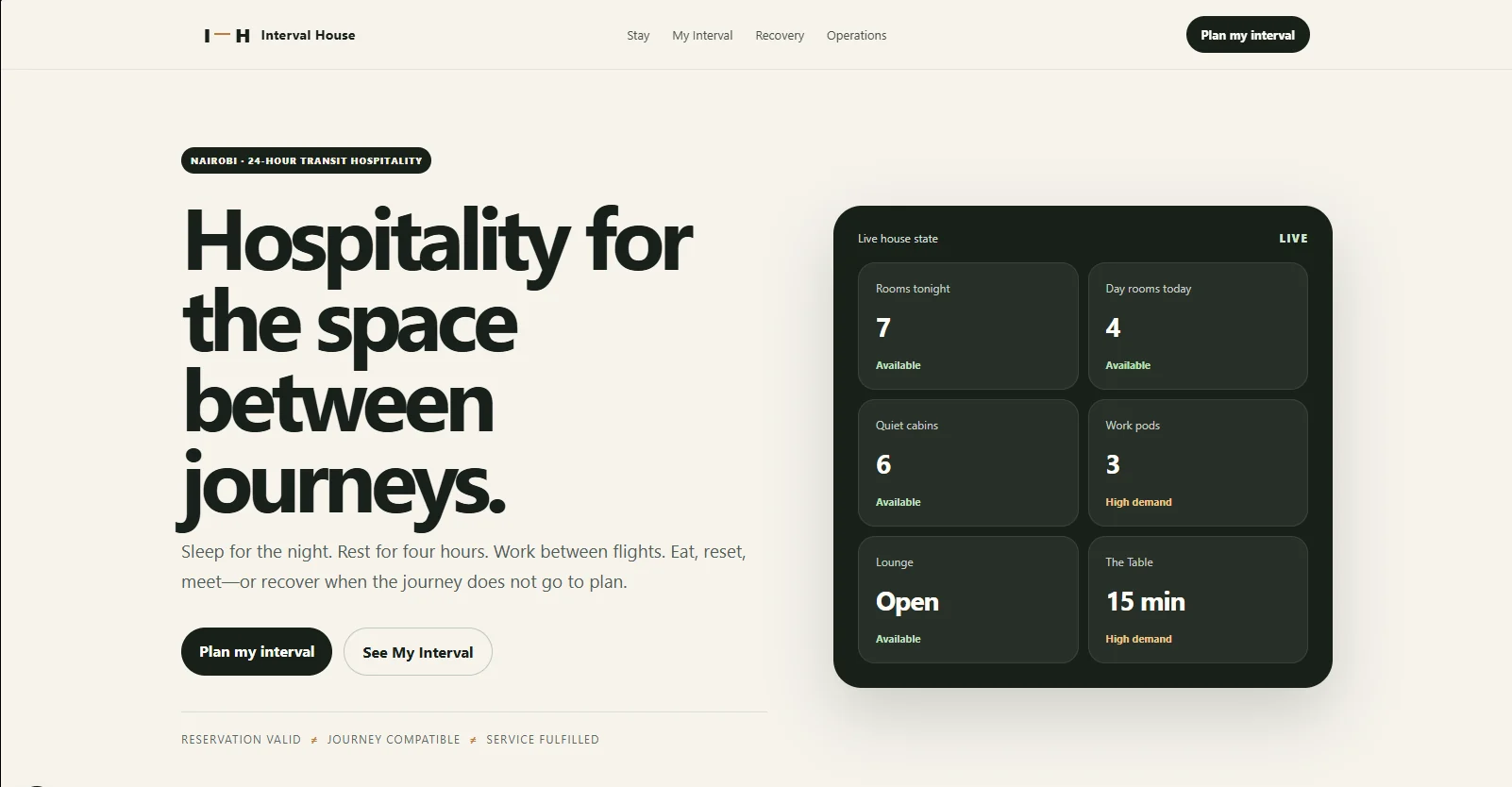
Interval House is a fictional 24-hour transit hospitality institution in Nairobi developed from KHDS Cases #31-40. It explores how journey state, entitlement, capacity, access and recovery can operate as separate but connected parts of one hospitality system.
A valid booking does not automatically mean a service can still be fulfilled in the guest's current state.
The research
Cases #31-40 moved beyond a single property format and examined hotels, lounges, transit hospitality, resorts, retreats, luxury rail, stadium hospitality and airport systems.
The goal was not to copy those institutions. It was to test which hospitality mechanisms survive when the guest relationship crosses different access states, capacities, operators and journey dependencies.
Lifestyle hotel
Airport lounge
Airside transit hotel
Integrated resort
Waterpark resort
Theme-park resort
Retreat
Luxury rail
Stadium hospitality
Airport hospitality
What the research taught us
The strongest recurring pressure was not simply product variety. It was the separation between what a person booked, what they are entitled to, what is currently accessible and what can actually be fulfilled.
A person can simultaneously be a room guest, diner, lounge user, transfer passenger or event attendee. Those relationships can have different access, capacity and lifecycle rules.
A valid reservation, pass or payment may establish entitlement while live capacity, timing, access or another dependency still prevents the service from being fulfilled.
An external travel change should not automatically invalidate every service inside the hospitality institution. Each relationship needs to be recalculated independently.
Flights, transfers, terminals, hospitality services and external partners can all affect one guest journey without being controlled by one operator.
A guest may physically leave while baggage, billing, recovery, communication or another responsibility remains unresolved.
Reservation valid ≠ journey compatible ≠ service fulfilled.
What we built
A state-aware guest dashboard separates journey state from service state and recalculates affected services when something changes.
Traditional booking systems often know what was purchased but not whether the guest's current journey state still makes that service usable.
Each service keeps its own eligibility, capacity, time window and access state.
Being a hotel guest does not automatically mean access to every lounge, event, wellness service, workspace or restaurant.
Rooms, lounge, showers, workspaces, restaurant, transfers and wellness operate as separate capacity pools.
A property can be sold out in one service while still having useful capacity elsewhere.
Every unresolved problem receives an owner, current status, next action and human escalation path.
Hospitality failures often disappear into vague escalation language such as 'we forwarded your issue.'
The operator view surfaces live demand and ranks recovery cases by consequence, urgency and responsibility.
Operational teams can prioritize issues by arrival time rather than actual guest consequence.
Operating principle
When Amara Njeri's fictional inbound flight is delayed by 5 hours and 10 minutes, Interval House does not mark everything as failed. Her room window shortens, lunch requires recovery, the transfer remains compatible and lounge eligibility remains valid.
The system changes only what the disruption actually affects.
Research to operating system
Why the architecture matters
Better hospitality architecture is not valuable because it is technically sophisticated. It matters when it protects revenue, makes capacity usable and prevents recoverable guest relationships from being lost.
A disruption does not automatically destroy the entire booking relationship. Usable services can remain active while affected ones are recovered.
Day rooms, lounge, workspaces, wellness and dining can create useful revenue even when overnight inventory is constrained.
Named ownership reduces dead-end handoffs and gives staff and guests a clearer understanding of what happens next.
Post-departure recovery, unresolved dependencies and future travel can remain part of the guest relationship instead of being lost at checkout.
What Kodawa Labs could implement
A real deployment would begin with the property's actual services, capacity rules, technology stack, partner dependencies and recovery responsibilities.
The goal is not one giant booking object. It is a connected system that preserves the boundaries between guest, relationship, entitlement, capacity, journey and recovery.
What Interval House demonstrates
Interval House is a fictional KHDS Track C research synthesis prototype representing Cases #31-40.
It demonstrates:
It is not presented as:
Track C implementation does not independently promote, validate or change confidence for any KHDS research pattern.
Kodawa Labs
Interval House asks hospitality software to understand more than the transaction. It has to understand the guest's relationship, entitlement, journey state, available capacity and who owns the next action when something fails.
A hospitality system should understand not only what someone booked, but what state they are in when they try to use it.